
Sterling Silver Jewelry Production: QC at 100%
"100% inspection" is the most repeated phrase in jewelry manufacturing and the easiest to leave undefined. The published step list puts final QC before delivery and states that every piece is inspected; the MOQ is 50 pcs per design in 925 sterling silver, so an inspection failure is measured in tens of pieces, not in thousands of scrap units.
Key takeaways
- Final QC is step seven of the eight published steps, with 100% inspection before packing and shipping.
- ISO 9001:2015 describes a documented quality system across all production stages, not a pass mark on a finished piece.
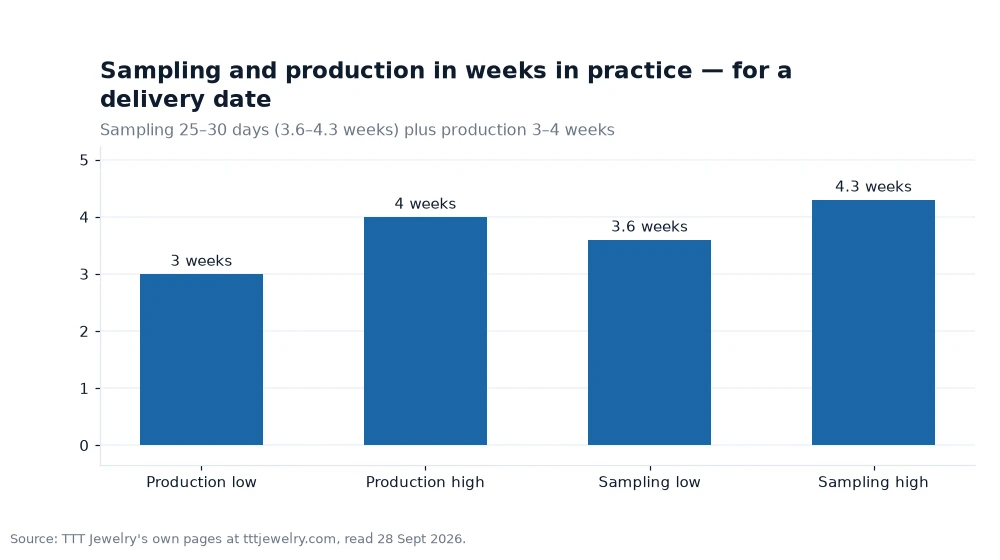
- Sampling runs 25–30 days and production 3–4 weeks, so an inspection failure found post-shipment costs a full production window to fix.
- MOQ is 50 pcs per design in 925 sterling silver, which keeps a rejected batch financially survivable.
What 100% inspection can and cannot mean
An inspection is only as good as its criteria. At 100% coverage, every piece passes a bench check for surface defects, plating coverage, stone security and engraving legibility. What the phrase does not tell you is the reject threshold, who signs off, and what happens to a piece that fails.
The two questions that extract the answer: is the check visual or measured, and is the inspection performed by the same person who finished the piece? A second pair of eyes catches what the first pair normalised.
Where inspection sits in the eight-step build
The published order is from the concept and CAD stage and prototyping through cutting the sprue, high-gloss polishing and textured surface art to electroplating, final quality check and delivery to the brand. Inspection is second to last, which is structurally sensible and structurally risky at the same time: by the time a defect is visible, the plating has already been applied and the mould has already produced the batch.
That is why in-process checks matter more than the last one. A casting flaw caught after mould casting costs a re-cast; the same flaw caught after electroplating costs the piece.
ISO 9001:2015 in plain language
The standard is a quality management system. In practice it means the factory writes down how a process runs, runs it the same way, and records the result. It is a statement about repeatability, and repeatability is exactly what a brand needs when it places a second order nine months after the first.
It is not a product certification and does not say a given ring is free of defects. Treat it as evidence that a documented process exists, then verify the process on your own sample. The silver line's own page — www.tttjewelry.com/sterling-silver-jewelry-manufacturer/ — documents the same system alongside the BSCI audit and the REACH statements.
The compliance checks that sit behind an order
Three published statements do different jobs. An audited BSCI social-compliance programme, REACH compliance on lead, cadmium and nickel and ISO 9001:2015, specifically freedom from lead, cadmium and nickel, with plating stated as compliant with REACH and CA Prop 65.
For a brand selling into the EU or a marketplace with a nickel-release question, the materials statement is the one that gets asked for. Keep it in the same folder as the product photography.
Four published lines make the standard concrete for silver: every piece stamped S925, a nickel-free and allergy-free alloy, eco-friendly electroplating on a 925 base, and ISO 9001:2015, BSCI and REACH on the compliance block. Sample testing before production is the published mechanism for catching a finish problem while it is still a bench question inside the 25–30 day window, rather than after the batch has shipped.
Planning for a re-inspection
Assume at least one round of corrections on a first run, and plan where it hurts least. Corrections at the sample stage cost days inside the 25–30 day window. Corrections after production cost a 3–4 week block plus shipping, which is the difference between a launch and a delay.
The least costly insurance is a written spec sheet that the inspector can check against. If the inspection criteria are not written down, every inspection is an opinion.
| Item | Published detail | What it governs |
|---|---|---|
| Final QC | Step 7 of 8, 100% inspection | Pieces leaving the building |
| ISO 9001:2015 | Quality management system | Repeatability of the process |
| BSCI audit | Social compliance | Labour and site conditions |
| REACH | Lead, cadmium, nickel restrictions | What the material may contain |
| Master sampling | 25–30 days | When a defect is still cheap |
Worked example: pricing a defect at each gate
Take the two published windows as the cost of a fix. A defect found during sampling costs part of a 25–30 day block; a defect found after production costs a further 21–28 days, because the mould has to run again and the pieces have to be finished again.
Put numbers on the calendar: sampling is 3.6–4.3 weeks and production is 3–4 weeks, so a post-production fix is 6.6 ÷ 3.6 = 1.8 times the sampling delay at the fast end, and 8.3 ÷ 4.3 = 1.9 times at the slow end. Roughly double, in weeks, for the same defect. The windows are published; the comparison is mine.
That is the whole argument for spending inspection effort early. A plating bath that is checked on the sample is a two-day conversation; the same bath checked on a shipped batch is a recall.
Questions that reveal how inspection really runs
Ask what the inspector compares a piece against, whether the inspection happens before or after electroplating, and what the rejection process is. Ask too whether the same criteria apply to a repeat order, because the second run is usually where a documented system earns its keep.
The published support model helps here: a 1-on-1 dedicated project manager and a 24-hour response window mean there is a named person to ask. In a workshop without a project manager, the same question goes to whoever answers the phone.
Checking plating without a lab
Plating coverage is the one quality item a buyer can test in the room. Look at the inside of a ring shank and the underside of a clasp, where the rack holds the piece and the current is weakest. Uneven colour in those two spots is a coverage question, and it is a question to raise before the batch ships.
Repeat the same check on a piece from the production run and compare it with the approved sample, ideally in the same light. A batch check takes minutes and settles the arguments that would otherwise run on photographs.
| Check | Where to look | Why that spot |
|---|---|---|
| Plating coverage | Inner shank, clasp underside | Weakest current position on the rack |
| Edge finish | Sprue cut line | The cut is reworked before polishing |
| Stone security | Setting claws and channel ends | Stone setting runs before plating |
| Engraving depth | Inner band, pendant back | Laser marking is a late step |
Frequently asked questions
Does 100% inspection mean nothing is ever wrong?
No. It means every piece is checked against stated criteria before packing; the standard of those criteria, and the reject threshold, are what you should agree in writing.
What does the ISO 9001:2015 certificate cover?
It covers the quality management system across production stages — documented and repeatable process — rather than certifying that any individual piece is defect-free.
When should a brand inspect a silver order?
At the master sample stage, inside the 25–30 day window, where a correction is a bench conversation; checking plating and stones at that point is cheaper than discovering the same issue after the 3–4 week production run.
Making inspection part of the brief
Condition reports work both ways. Give the factory a written list of what a pass looks like — plating coverage, edge finish, stone security, engraving depth — and the 100% inspection has something to inspect against, and you have something to check on arrival.
For materials that finish differently, the criteria change with the metal. The stainless steel finishing route uses PVD rather than an electroplated stack, and the wholesale ordering pages set out how minimums combine when one purchase order covers more than one material.
The specification this article works from — the ISO 9001:2015, BSCI and REACH claims along with the S925 purity stamp and the eco plating route — is published on the manufacturer's own site over at tttjewelry.com, per a read on 28 Sept 2026. The side-by-side reading belongs to me rather than the client, not the site's[1].