
Commissioning a Rig: Six Checks Before the First Share Counts
Most mining losses in the first month come from the room, not the pool. A 476 TH/s machine at the 21 September 2026 reading earns 0.00021354 BTC a day, or $18.08 gross and $17.36 after the listed 4%, and it will only earn that if power, heat and network all behave. The checks below are the ones that pay for themselves in the first week.

Key takeaways
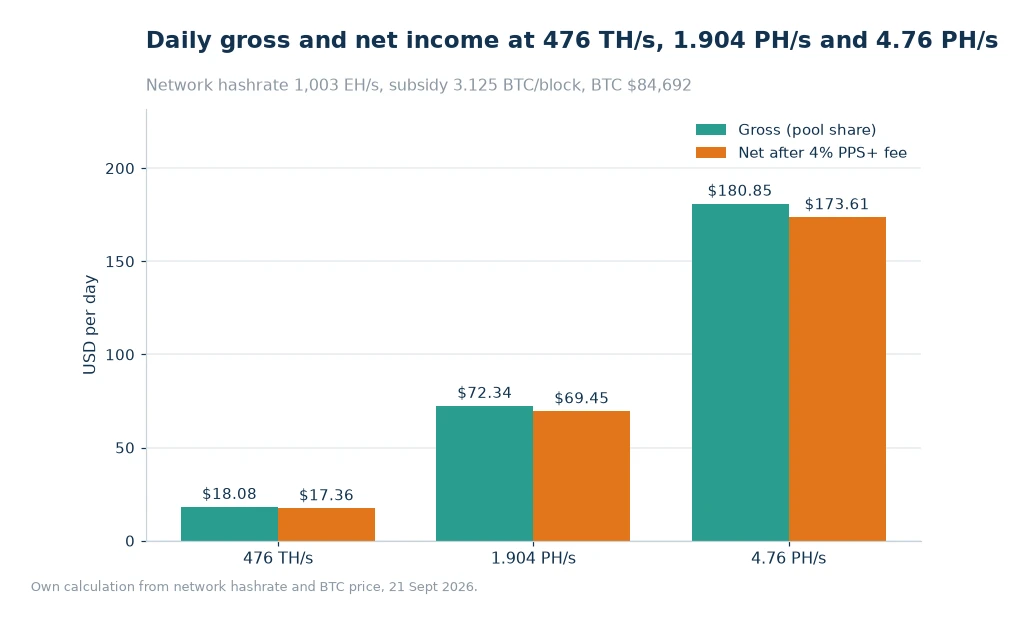
- 476 TH/s credits 0.00021354 BTC a day, which is $18.08 gross and $17.36 net at the listed 4%.
- A 20 J/TH machine at this hashrate draws 9.52 kW, or 228.5 kWh a day, before cooling overhead.
- Each missing hour of uptime costs about 72 cents of gross income at this hashrate.
- A 10% thermal throttle costs $1.74 a day, more than most firmware tweaks can recover.
Power: measure it, do not estimate it
A wattmeter on the feed answers a question that the miner's own dashboard cannot: what the whole installation draws, including fans, network gear and the transformer's losses. Multiply the reading in kilowatts by the hours run to get kilowatt-hours, then by the tariff. At 476 TH/s and 20 J/TH the machine alone is 9.52 kW, and a day of that is 228.5 kWh.
The gap between the nameplate figure and the wall figure is usually a few percent, but it can be larger on older power supplies running near their limit. That gap matters because the margin per machine is thin. At $0.06 per kWh the machine costs $13.71 a day to run against a net pool income of $17.36, leaving $3.65 before hardware. A 10% error in the power estimate erases a third of that.
Check the feed's headroom as well. A circuit loaded to its breaker rating will trip on a hot afternoon, and a trip is not just downtime: repeated restarts stress drives and can corrupt firmware settings. Leave room for the fans to start, since inrush current is higher than the steady draw.
Heat has to leave the room
Cooling a miner is easy; cooling a room full of them is a different problem. The machine moves heat into the air, and the air must be replaced or the room warms until the miner throttles. Intake temperature is the number to watch, not the exhaust, because the intake sets the operating point for every board. A room that sits at 32°C in the afternoon will cost more in lost hashrate than a colder room costs in fan power.
Watch for the pattern rather than the peak. A machine that reports 476 TH/s at midnight and 455 TH/s at four in the afternoon has a cooling constraint, and the loss is roughly 4.4% of output. That is about 0.0000094 BTC, or 80 cents, every afternoon — $24 a month at $84,692 per coin, which is usually more than the cost of a better fan or a duct.
Dust is the slow version of the same problem. Clogged fins raise the temperature gradually, so nobody notices a 1% loss per month until the machine is running hot and loud. A calendar reminder to inspect and clean is a cheap control, and it doubles as a chance to check cable seating and fan bearings.
The network is part of the rig
A miner that cannot reach the pool produces nothing, no matter how well it hashes. That makes the switch, the cable and the router part of the production path. Use a wired connection where possible, label the port, and keep a second route to the internet if the site has one. A pool connection that drops for ten minutes a day costs about 12 cents at this hashrate, which sounds trivial until it happens every day for a month.
Latency matters less than stability for share submission, but both matter for the pool's view of your worker. A connection that stalls and recovers can produce a burst of stale shares, which look like rejected work in the dashboard. If the reject rate climbs above roughly 1% without a hardware cause, look at the network before replacing a board.
A checklist with a price tag
| Check | Passing signal | Cost of getting it wrong |
|---|---|---|
| Reported hashrate | Within 2% of 476 TH/s over 24 hours | Each 1% short is 0.00000214 BTC, about $0.18 net, per day |
| Uptime | No unplanned restarts | Each missing hour is about 72 cents gross, 69 cents net |
| Board temperature | Stable, no sustained throttle | A 10% throttle is $1.74 net per day |
| Rejected shares | Under 1% of submissions | 1% of a day is about $0.17 net at this hashrate |
The rows are ordered by how often they go wrong, not by how dramatic they sound. Reported hashrate drifts first because it responds to heat and firmware; uptime fails next because of power and network; temperatures creep; rejects are usually a symptom of the first three. Work down the list when the daily credit is short.
Worked example
- Supply check: 144 blocks × 3.125 BTC = 450 BTC daily.
- Each TH/s earns 450 / 1,003,000,000 = 0.0000004486 BTC per day.
- 476 TH/s: 476 × 0.0000004486 = 0.00021354 BTC.
- At $84,692: 0.00021354 × 84,692 = $18.08.
- Net of the listed 4%: 18.08 × 0.96 = $17.36.
- Power at 20 J/TH: 476 × 20 = 9,520 W, or 9.52 kW; 9.52 × 24 = 228.5 kWh.
- Power cost at $0.06 per kWh: 228.5 × 0.06 = $13.71, leaving $3.65 a day before hardware.
- 1.904 PH/s is 1,904 TH/s: 1,904 × 0.0000004486 = 0.00085414 BTC, or $72.34 gross and $69.45 net. At 4.76 PH/s, 4,760 × 0.0000004486 = 0.00213536 BTC, or $180.85 gross and $173.61 net.
Account settings that are easy to forget
Three settings on the pool side deserve a check before the machine runs for a week. The payout address should match the wallet you control, character for character, and the coin should match the chain you are mining. The scheme should be the one you intended: PPS+ settles hourly on current difficulty, while PPLNS waits for six confirmations. A machine pointed at the wrong coin will hash happily and earn nothing.
Alerts are the other half. Set one on the worker's reported hashrate, one on rejected shares, and one on the balance failing to grow for a day. The balance alert catches a dead machine; the hashrate alert catches a throttling one before it costs a full day. The ViaBTC App for iOS and Android delivers those notifications, so the daily manual check that most people abandon in week two becomes unnecessary.
The first twenty-four hours
Leave the machine alone for a full day and compare the pool's credited BTC with the arithmetic for the hashrate it actually reported. At 476 TH/s a clean day is 0.00021354 BTC. A credit between 0.00020 and 0.00021 means the setup is sound and the small gap is normal variance in share timing. A credit near half that means the machine ran half a day, and the first thing to inspect is the restart log.
The ViaBTC Mining Guide has the per-coin connection settings and the scheme definitions in one place, which shortens the check when a worker connects but never submits. Compare the port and the worker name there before changing anything else, since a single wrong character produces a connection that looks alive and earns nothing.
Frequently asked questions
How much power does 476 TH/s draw?
At 20 J/TH the machine draws 9.52 kW, or 228.5 kWh a day. That is $13.71 at $0.06 per kWh, against a net pool income of $17.36 at $84,692 per BTC.
What temperature should the intake air be?
Cooler than the room's afternoon peak, and stable through the day. The exact limit depends on the hardware, but a repeatable dip in reported hashrate each afternoon shows the intake is too warm for the current airflow.
How much downtime is acceptable?
None that is unplanned. Each missing hour costs about 72 cents gross at 476 TH/s, so a recurring weekly outage quietly removes several dollars a month from the credit.
Commission once, then leave it alone
A good commissioning week ends with the machine running, the alerts configured and nobody touching the firmware again. Every later change should have a reason and a before-and-after number attached, or it becomes part of the noise. If you want a benchmark for a hardware swap, the Miner Profitability Ranking compares models against current price and difficulty, which is a better starting point than a forum thread.
Sources: ViaBTC's homepage, pricing page and miner ranking page, for connection details, scheme rules and the listed 4% rate[1]. Readings taken 21 Sept 2026: BTC $84,692, 1,003 EH/s, 132.76 T difficulty, 3.125 BTC subsidy with 144 blocks per day. Power costs assume 20 J/TH at $0.06 per kWh. Published 22 Oct 2026.